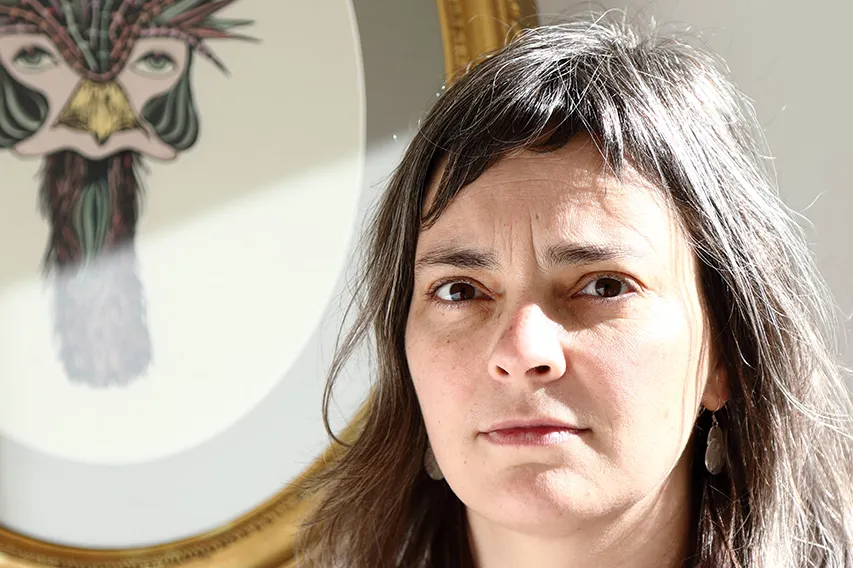
Violaine Fayolle at La Malterie, August 2025 – © Claire Nicol
What technique(s) do you use?
Born in 1981, Morbihan-based visual artist Violaine Fayolle has focused her work since 2005 on the monstrous and the norm, using various media including wood engraving and ceramics.
Since 2014, she has been playing with hybrids that highlight the complexity of human beings. With them, she opens up new narratives that she continues to develop to this day.
In 2021, she received individual creative funding from the DRAC Bretagne. She has led numerous artistic projects with Pass Culture funding, joined the Jeune Gravure Contemporaine group in Paris and became curator for the Morsure #2 exhibition at the Archipel de Fouesnant, dedicated to printmaking. She is the secretary general of Manifestampe, the national printmaking federation.
Represented by the Gloux (Concarneau) and Out of the Blue (Lille) galleries, her works feature in public collections, in the prints and photography department at the BnF, in art libraries in France, and in the xylography museum in Brazil, among others. Winner of the Fondalor sponsorship fund in 2023, she is carrying out a participatory project in Lorient. The work is permanently installed in the heart of a tree-lined square specially designed to accommodate it in June 2025. She received two awards in 2025: the Arches/Antalis prize at the Taylor Foundation for two prints during a group exhibition organised by Pointe et burin, and the Faïen Museum prize.
Make an appointment at the artist studio
Adress : 16 rue de Kerlouano — 56100 Lorient —France
tel : 0033+6 21 53 01 99
n° de SIRET : 504 637 091 00035
The ambiguity is clear to those who take the trouble to observe it. Some see it and let it pass. Others get bitten. Still others ask themselves questions, intrigued.
A freak show monster, a hidden monster. A stigmatised monster who goes into exile for fear of being rejected.
The monster, the one who is shown. The one who looks so much like humans but who, deep down, feels rejected by this category in which he cannot recognise himself.
The monster: the one who does everything like everyone else, but who can only give the illusion of normality.
Is there anything else besides monsters?
Are there beings who do not feel like strangers?
Violaine Fayolle
|
Approach Violaine Fayolle's works offer viewers a range of possible experiences that encourage them to question humanity — these animals unlike any others — and the meaning of their lives and actions, between smallness and greatness. Her works are designed to enrich the viewer's perspective on the world. In the visual arts since the Middle Ages, the figure of the monster has distanced the viewer by being presented as other, and in the same way, the figure of the madman repels and fascinates at the same time. Both appear as hidden mirrors of human complexity and raise the question of the norm. In line with these reflections, Violaine Fayolle creates hybrid beings, but models a space in which Manichaeism does not exist: everyone is good and bad, singular and complex, the baseness of beings persists, it is neither denied nor denounced. Human beings, despite all their efforts, are intrinsically shaped by their imperfections and steeped in paradoxes. Simplification is not possible. Assembling naturalistic sketches from plant, animal and mineral materials, her imaginary works form part of a whole. Each piece contributes to the construction of new narratives, presented to the viewer in a figurative aesthetic. Playing with the codes of figuration and illusion, Violaine Fayolle brings to life an offbeat universe that is both funny and multi-layered. The question of limits, on the edge of tensions and paradoxes, central to what she shows, is also at the heart of the techniques she appropriates for her projects: wood engraving, porcelain ceramics and other installations. She is always seeking new creative challenges in which she attempts to overcome the material and technical difficulties posed by the laws of physics and matter through her work and determination. Beyond the works themselves, Violaine Fayolle scatters clues about the genesis of her creation throughout her exhibition, offering an experience in which the viewer searches, understands and contributes to the writing of the narrative. In her highly orchestrated stagings, every detail counts. Violaine Fayolle's works leave behind a trail of clues to follow, oscillating between repulsion and seduction, which run through a complex body of work questioning the paradoxes of humanity in relation to living beings, in which the viewer finds ‘the echo of questions that are both intimate and universal’[1]. [1] Preface by Solenn Dupas to Les Messagers, by Kornelius Corax, woodcuts by Violaine Fayolle, Editions Kutkha, 2012. |
Night figures, presences of light
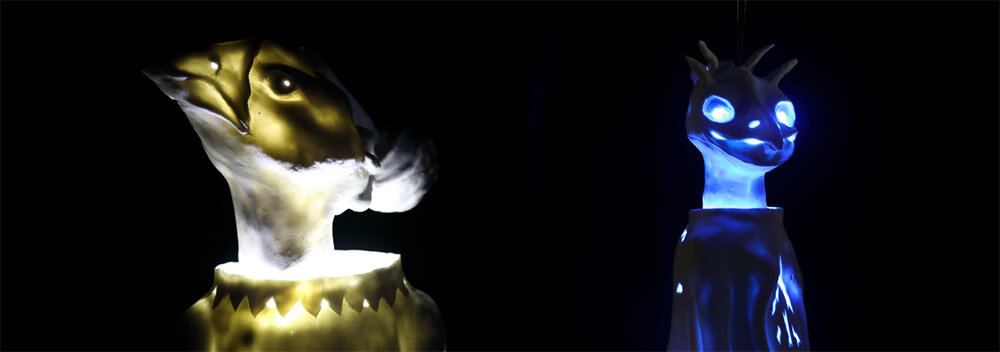
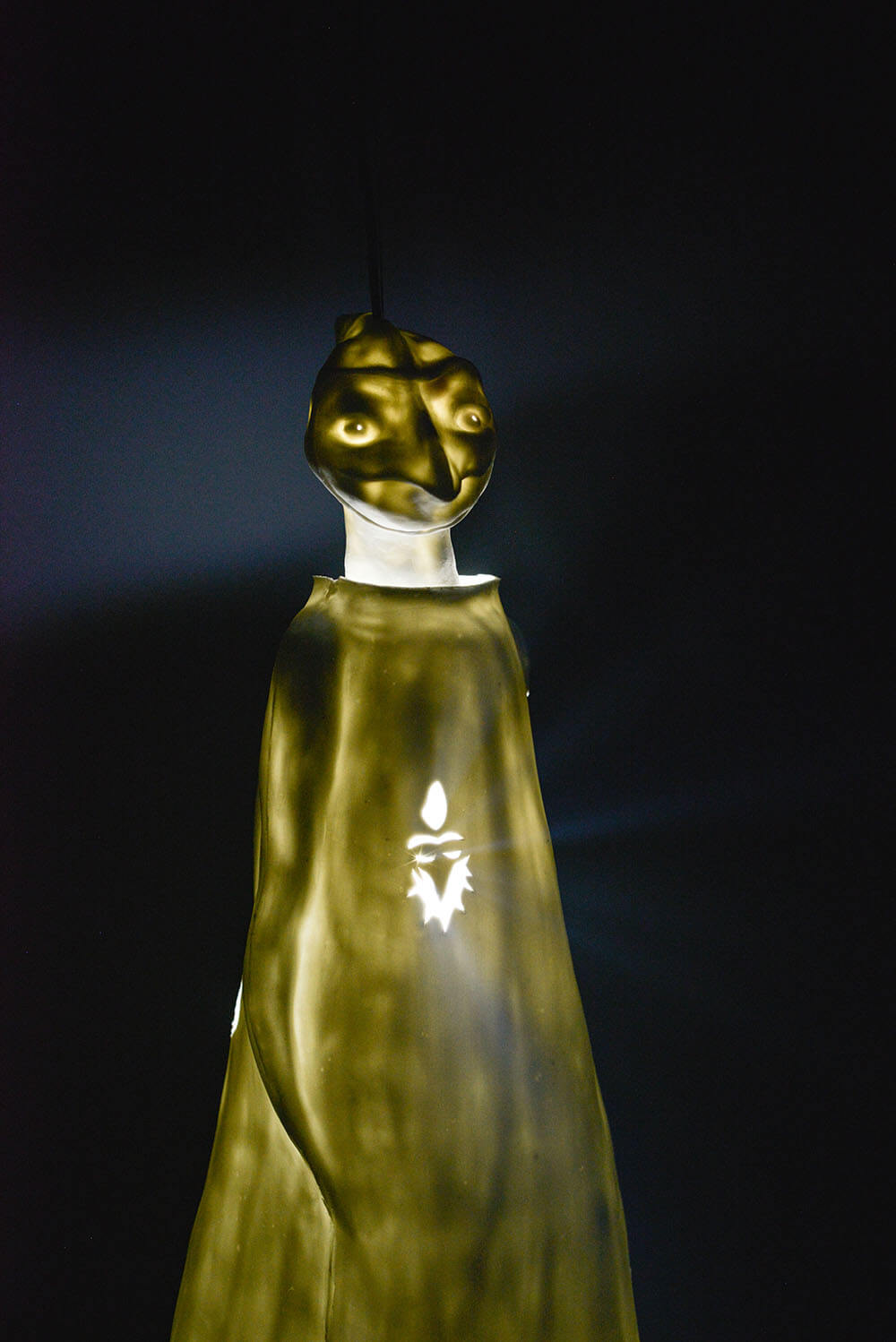
Enigmatic figures float in the darkness. Tall silhouettes of openwork porcelain, topped with bird heads – somewhere between Horus and the black crows of the Venice Carnival – Violaine Fayolle's Great Elders stand motionless and silent in an uncertain space. Neither ethereal nor chthonic, they are tangible but weightless. They seem to have been born from the depths of human night, and their presence has the power of an apparition. From within each one emanates a light, mostly yellow, but blue in one case, which shines through openings in the form of symbols inspired by Lascaux, sea urchin skeletons, and animal or plant traces. These are all primary motifs, as if these beings had preceded humanity and yet already carried its memory.
Are they distant, forgotten gods, half-human and half-bird, from some intimate cosmogony or a Lovecraftian world that the title of the work inevitably brings to mind? Or are they masked characters, shamans or sorcerers performing some terrible, impenetrable ceremony, summoning invisible forces? Are they nature spirits, like those that appear in Hayao Miyazaki's animist tales? Do their robes not feature motifs borrowed from prehistoric cave art, with organic forms – here drawn or stamped (sea urchin skeleton, bird tail feathers, plant objects) – to that monstrous and radically foreign nature, never just ‘gentle’ or ‘hospitable’ for that matter, to which Violaine Fayolle, an avid and voracious draughtswoman, is so attentive?
If viewers wonder what exactly the artist ‘meant to say’, they should consider his art as a dream projected onto matter. Just as dreams produce and offer up strange, ambiguous images whose meaning is not fixed, so too do his enigmatic yet familiar works allow for a multitude of interpretations. This is the exact opposite of works that come with instructions, in which artists impose a meaning that they control – their single meaning. Here, nothing is unambiguous, but rather presences available to the imagination.
While this work conjures up images of primitive gods from a time before time itself, the clue suggested by its Lovecraftian title could be misleading. These original deities, which could just as easily have come from ancient mythologies, can be thought of as psychic archetypes, symbols of the primitive forces that inhabit us, forces of chaos and death, love or order.
Neither shamans nor gods, these creatures could be monsters – so familiar in the art of Violaine Fayolle, who metabolises a passion for gothic and fantastical creatures, Jérôme Bosch, Bruegel, Goya and the yōkai, those demons of Japanese folk superstitions. "In biblical tradition, the monster symbolises irrational forces: it possesses the characteristics of the formless, the chaotic, the dark, the abyssal. The monster therefore appears disordered, devoid of measure, evoking the period before the creation of order [...]," according to Jean Chevalier and Alain Gheerbrant's Dictionnaire des symboles (Dictionary of Symbols).
This work can therefore be interpreted in a wholly subjective manner, where the monstrous does not stem from fear or archaism, but from a form of mise en abyme of our own otherness. Just as light passes through the openings, like so many cuts in the figurines, so too can the fire of each individual being transcend scars and cracks – physical and psychological – and be transformed into a capacity for joy. The wound becomes a place where light passes through, and therefore a place of transformation. Through them, shame is turned into pride, suffering into uniqueness, distress overcome by the capacity for giving, caring, love, mercy and compassion. As Leonard Cohen sang, "there is a crack in everything; that's how the light gets in".
But the light does not remain confined: it escapes through the openings, touching others – the viewer and the other characters –; it dispels the fiction of isolation, suggesting a sociality where light circulates, where each person shines on others and also receives. Although immobile, the Great Elders are connected: they illuminate and reveal each other. The wound, transformed into light, is no longer merely intimate: it becomes a bond. In the recognition of our own fragility lies the capacity for empathy and mutual aid that binds us to one another and makes even darkness habitable.
What connection, then, could there be between these two imaginaries – one, genesis-like, of a primordial world; the other, more intimate, of overcome trauma? On the one hand, all cosmogony is brought order out of chaos, and the Great Elders symbolise this archaic force of transforming disorder into a habitable world. On the other hand, the “masks” or bird heads evoke various myths that link the earth and the sky, the world of the living and the world of the gods. Whether the Great Elders are shamanic figures or gods, they perhaps speak to us, like archetypes, of our ability to turn darkness into light, cracks into passageways, and solitude into encounters.
Without establishing a fixed, singular, definitive truth, these few reflections show how unstable and uncertain a work is that seems to emerge from the depths of dreams, sharing their enigmatic nature.
« The wingless».
Family portrait.
This is the title of an unexpected universe, discovered in the spaces of the Archipel in Fouesnant, during Violaine Fayolle's installation in the spring of 2025. An artist with a keen naturalist sensibility, she observes the beauty and monstrosities she discovers in nature, but also in museum collections. She draws them, collects them and transforms them in her studio, a veritable cabinet of curiosities. It is there that the hybrid beings known as ‘Les Désailés’ are born, grow and evolve, giving rise to an imaginary lineage that comes to life in a world entirely recreated by the artist.
After witnessing the ‘gestation’ of the Désailés in her studio, we discover the ‘birth’ of small bird-like characters with atrophied wings that no longer allow them to fly. Each one is carefully described with its first name and personality. Violaine Fayolle presents these small hybrid creatures to us through her drawings and prints.
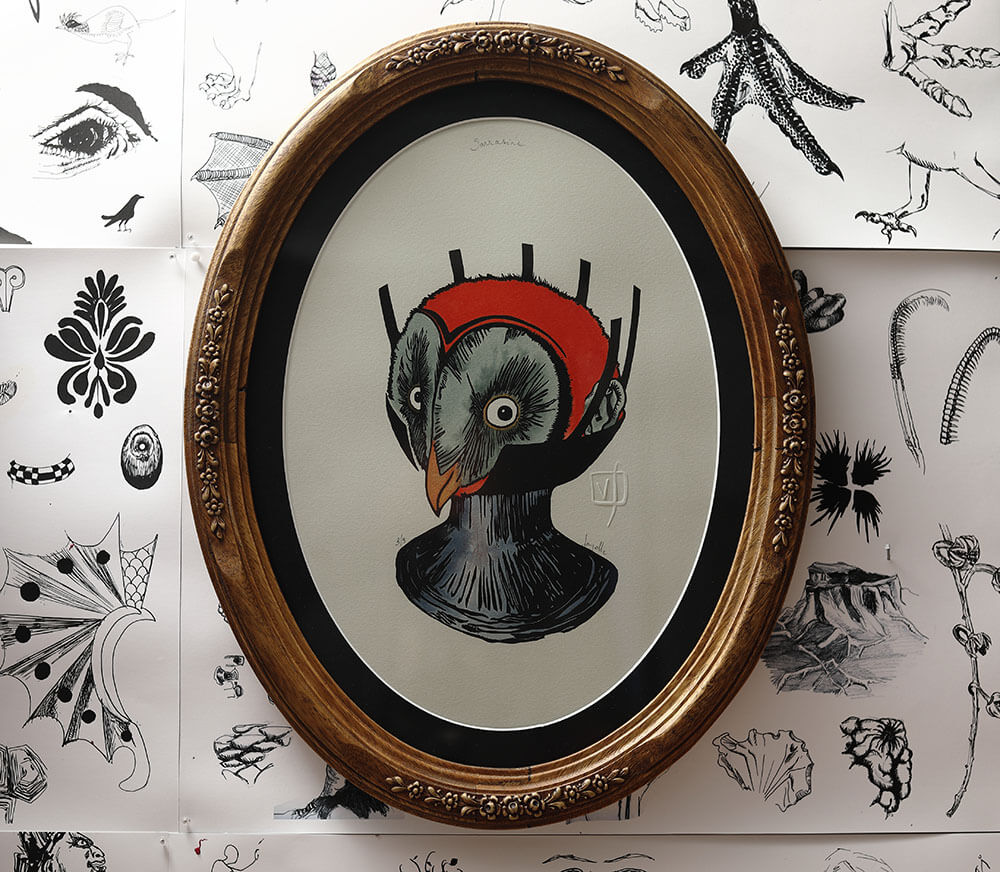
But before delving further into the Désailés family tree, we are presented with a gallery of portraits in antique frames: “the gallery of ancestors”. They could fly, before a genetic accident disrupted their lineage! What could this catastrophe be? The exhibition leaves us to imagine.
After this return to the past, let us return to the present generation and continue our journey into the world of these whimsical and joyful little beings that emerge from the drawings and engravings. Ceramic figures occupy the most unusual places in the space, giving the illusion that they are rediscovering the sensations of their winged ancestors. They populate several scenes of life and play: ‘the offspring’, ‘the escapade’, ‘the little theatres’, ‘nature’. ......
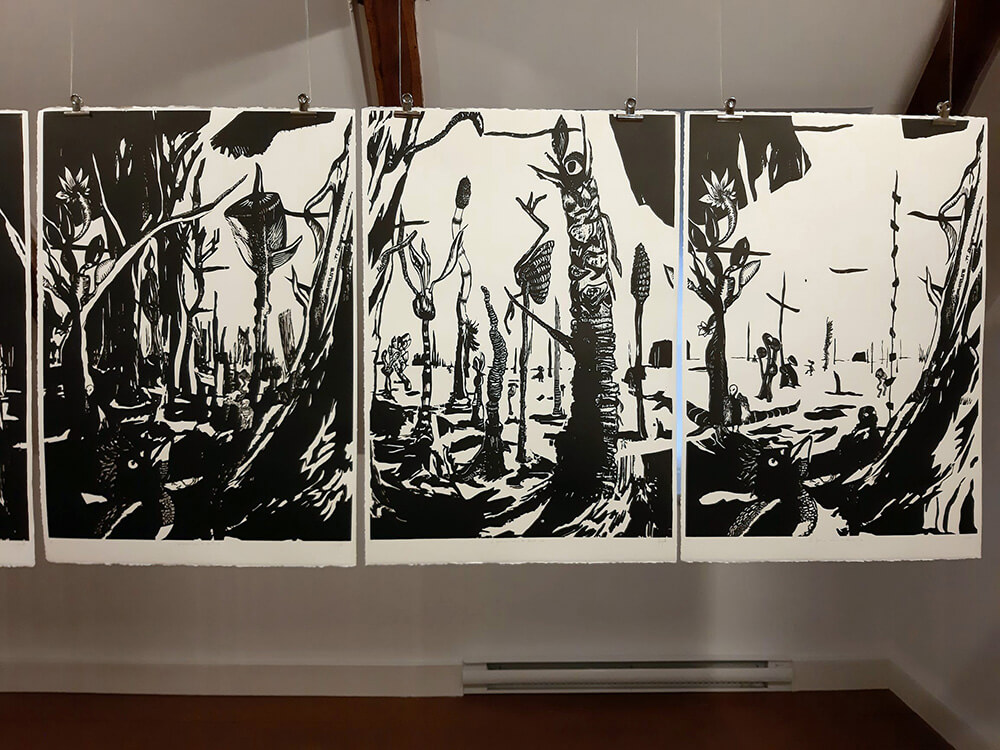
‘The Forest’, whose history and evolution we discover in a series of nine engravings, from its very dense and populated origins to an empty forest with only a few skeletal trees... Is this the cause of the genetic catastrophe that led to the appearance of this highly humanised bird-like species?
To conclude this saga, a symbol of evolution, Violaine Fayolle invites us to welcome, in a memorial crypt, three mysterious characters, draped in light: ‘the Great Ancients’ at the origin of the Désailés lineage, even before ‘the gallery of ancestors’.
Through her drawings, engravings, sculptures and installations, created from observations of artefacts of Nature, Violaine Fayolle draws us into an ecological science fiction tale that questions the future of our societies. Her small characters, birds with terribly human postures, question us about the meaning of life and our attitudes in the face of current challenges.
Fouesnant, 27 October 2025
Jacques Maigret, Curator of Scientific, Technical and Natural Heritage
In a few words, how would you describe your art?
I create dreamlike worlds filled with hybrid beings that I use to showcase the complexity of humanity.
What are the subjects that inspire you?
I turn to nature – plants, minerals and animals, including people – for inspiration. I draw my subjects with a naturalist’s eye and compile my drawings in sketchbooks. These become the foundation for all my pieces.
The wise Owl is a Literary & Art India monthly magazine.
Rachna Singh, Editor, The Wise Owl talks to Violaine Fayolle, an artist based in France. Between engraving and metamorphosis, Violaine Fayolle’s work conjures a world of shifting identities — half-human, half-creature, always in transformation. From the tactile intimacy of woodcut to the alchemical process of ceramics, her practice gathers fragments of matter and myth into a cabinet of wonders where curiosity itself becomes a mode of survival. A member of the Jeune Gravure Contemporaine in Paris, curator of the “Morsure #2” exhibition at Archipel de Fouesnant, and now General Secretary of the National Printmaking Federation, Fayolle continues to weave connections between gesture, community, and the imaginary. In 2023, she received the Fondalor patronage prize for a public art project soon to take root in a tree-lined square — a permanent encounter between art and landscape
Rachna Singh, Editor, The Wise Owl talks to Violaine Fayolle, an artist based in France. Between engraving and metamorphosis, Violaine Fayolle’s work conjures a world of shifting identities — half-human, half-creature, always in transformation. From the tactile intimacy of woodcut to the alchemical process of ceramics, her practice gathers fragments of matter and myth into a cabinet of wonders where curiosity itself becomes a mode of survival. A member of the Jeune Gravure Contemporaine in Paris, curator of the “Morsure #2” exhibition at Archipel de Fouesnant, and now General Secretary of the National Printmaking Federation, Fayolle continues to weave connections between gesture, community, and the imaginary. In 2023, she received the Fondalor patronage prize for a public art project soon to take root in a tree-lined square — a permanent encounter between art and landscape.
Here, she reflects on hybridity, curiosity, and the silent stories that dwell within matter.
Hi Violaine, thank you for taking time out to talk with The Wise Owl about your creativity and art.
RS: Your work moves fluidly between engraving, sculpture, and ceramics — materials that require touch, patience, and resistance. How do you know when a form demands to be cut into wood rather than shaped in clay? How do you decide which medium best conveys a particular narrative or emotion?
VF: Above all, I seek to create an emotion, a sensation, in those who view the works, to touch the audience through the visual senses, beyond words. I believe that each medium has a different impact, and I am found of everything that can be seen or touched; I mean textures, materials, and mediums. In the two dimensions of wood engraving, I can create illusions of space that allow me to open up an imagination that goes beyond what the material — constrained by the physical laws of gravity, weight, and force — can offer. I choose a medium for what it allows me to imagine and evoke in the eyes of the spectator. Woodcut, for example, induces a raw aesthetic, but also, when I practice it intensely, it leads me, through the constraints it imposes, to reflect on ideas that would never have been born if I had worked with another medium.
So, the idea for my forest, woodcuts using lost plates that go from darkness to light, came to me as a result of working with the medium of woodcut. Only this medium and the very strong constraints associated with this technique in this project allowed me to create this work. In terms of volume, I have many more technical constraints related to physics (gravity, material, etc.), but this gives the works a disturbing presence that is more explicit and concrete than in two dimensions. Also, in choosing porcelain as the material for the volume, I sought to bring delicacy to a proposal that is quite raw in substance. Each choice of material will have an effect, and I am very sensitive to this. For a new idea, I look for the right medium and practice with it as long as necessary. At the moment, I am training myself in the creation of moulds for volume, in order to continue exploring the direction I have recently taken in the creation of the installation Les grands Anciens [Violaine 4] (The great Elders, moulded porcelain pieces lit from within.
RS: Since 2014, you’ve created hybrid beings. These hybrid forms blur boundaries between human, animal, and object — what draws you to these transformations, and what do they reveal about human complexity today?
VF: Human beings like to simplify and to caricature everything, and I seek to offer a complex visual universe that disrupts this Manichean and reductive perception of the world. I am tired of these unilateral thoughts that do not accept debate or disagreement. Humans are paradoxical. Nature, of which we are a part, has no particular intention; it is content to simply be. I seek to show viewers this richness all around them and the complexity of human beings. We are animals. Different from other animals, of course, but we are animals with urges that we would like to reject but which exist. It is a question of going through the animal and hybridisation to see humans differently and question them about what they are.
RS: Your universe evokes the ancient Wunderkammer, where wonder, science, and myth once coexisted. What does the cabinet of curiosity mean to you today — a relic of past fascination, or a living metaphor for the complexity of our inner worlds?
VF: The creation of my own cabinet of curiosities is a daily practice deeply connected to the intimate: every day, I observe the pictorial richness that nature offers to inspire me, to draw from it and use it as raw material, as visual nourishment. This has been my daily routine for years. And even if it comes from a historically dated practice, the cabinet of curiosities created by someone traces the path and twists and turns that their life may have taken, the objects that their eyes have encountered and loved. It is within everyone's reach to open their eyes to the world around them. Whether our environment is rural or urban, insects always find a place to nest in our living space, whether it be spiders with their velvety legs or woodlice with their ingeniously arranged plates forming their exoskeleton. A patch of sky or night sky always teaches us about colours. Everything can become a source of wonder. I can be fascinated by a nightjar or a moray eel because I find them repulsive and this repulsion makes me question myself. So I try to draw them. It's the same with humans and their reactions, which I always observe with a little distance and curiosity. I like this idea of a living metaphor for the complexity of our inner worlds. This approach to drawing nature has become so important in my work that I wanted to feature it in the scenography of my latest solo exhibition, to also show the nourishment and genesis of imagination. This gave rise to the installation called Le curieux atelier (The Curious Workshop).
RS: Melchior, Guy, and other enigmatic figures appear throughout your work, like emissaries from an unknown mythology. Who are they to you — alter egos, companions, or mirrors of collective memory?
VF: These characters are made up of elements sketched from nature, and they are all different. Some, like Melchior, come from a flower such as the hibiscus, following a commission based on this flower. Others, like Guy , who is actually my father, are real people from my circle whom I have metaphorically transformed into characters who feature in the story I am telling. I worked on Guy based on the tree. My surname, inherited from my father, Fayolle, means ‘place planted with beech trees’, and my father devoted his life to plants and landscape design. Sometimes, I represent myself. Alter egos, of course, companions who also accompany me, and also mirrors of animals/humanoids that can echo emotions and experiences felt by the viewer. Ultimately, they are there to show a variety of specimens, all unique, but apparently belonging to the same species. That's what fascinates me about living beings: a similar matrix unites us, but it is so complex that we are all unique and different.
RS: In curating Morsure #2, you invited artists to explore printmaking. How did this experience shape your own perception of engraving ?
VF: This curatorial work had a major impact on my perception of engraving and my understanding of my own work, even though it was not on display. The commission from the exhibition venue required a diverse range of proposals, and I created a link around the theme of metamorphosis between humans and animals. As a self-taught wood engraver, this forced me to open my eyes to other techniques with which I was unfamiliar: copperplate engraving, medieval-style stencil illumination, mezzotint... and this led me to a more subtle perception. I also invited several wood engravers who became friends. The encounters that this curatorship has enabled have opened me up to other ways of working, other areas of research in printmaking, some of which have had such an impact on my own work that they still influence the direction I may wish to take today.
RS: As General Secretary of the National Printmaking Federation, you are at the crossroads of tradition and innovation. How do you see engraving evolving in an age saturated with screens and instant images? How do you envision supporting the next generation of printmakers in a rapidly digitalizing art world?
VF: This question is at the heart of some of our reflections at Manifestampe. First of all, multiples allow us to create unique works at low cost for an audience that appreciates handmade work, not necessarily collectors, who find there a way to begin in art acquisition. Digital images are not incompatible with printmaking, quite the contrary. Tradition is not opposed to innovation. I also use digital technology in my images on a daily basis. But the physical act of engraving, where I struggle with the wood, is a time of necessary concentration and is precisely different from the time spent on the computer, where everything can be recorded and evolved infinitely. The gouge engraves the wood and mistakes cannot be repaired. This tension is valuable and a source of great creativity. The constraints it imposes are fertile. The young generation of engravers, which Manifestampe has been supporting for two years with a young artists' prize, is encouraged to integrate digital printmaking with physical matrix and printing techniques. Manifestampe seeks to give greater visibility to printmaking and to popularise knowledge of this relatively unknown medium among a wider audience. Today, as images are so easy to create digitally and duplicate through reprographic, printmaking is evolving, as are the issues addressed by artists. It is turning towards monoprints, unique works, and towards the experimentation offered by combining different matrices. Finally, matrices can be used, as wood engraver Roby Comblain does, as material for installations. This is one of the directions I am also taking.
RS: The Fondalor award has led you toward a permanent outdoor installation. How does creating for a shared, outdoor space alter your relationship with audience and permanence? Did it shape your creative process in any way?
VF: Creating for a public outdoor space shared by everyone has given my work a lot of meaning, because I believe that artists have a role to play. And even more in this case, where the works were created through a participatory process involving around seventy residents from all social environments. I wonder about the place of the artist in society and the role they should play in this society where everything is tense, where everyone is turning in on themselves, where relationships with others are closing down. What is their place in society if they spend their whole life creating alone in their studio, without any connection to their audience of collectors, an elite managed by their gallery owners? For my part, I seek encounters around my work and what it shows others. Of course, creating for other people and identifying them opens a new creative process. In this project, I offered the residents two different installations, one that I preferred, which was more of a contemporary work of art to be contemplated, and another that was more playful. The more playful one received the most votes, particularly because several children had participated in the project and were very attached to it. It became La ribambelle [Violaine 8] (the string of). It makes a lot of sense to me that the project the residents preferred is the one that was installed.
RS: You often speak of “opening new narratives” about human complexity. If your oeuvre were a story, what chapter are you writing now — and what questions remain unanswered for you?
VF: At the moment, I am developing those narratives towards a more intimate atmospheres, exploring ideas that aim to reach as wide an audience as possible, a process I began with my great Elders. I am trying to go back to prehistoric times, to those first artists, to touch on the foundation that everyone carries within them, the heirs of a past that maybe we don’t really understand. So this would be a chapter that goes back even further than the two or three generations I have tried to show so far? I have thousands of unanswered questions! I try to answer them a little by working, by creating. And so, for now, I'm focusing on the ones I'm working on. How can we touch everyone through the feelings about our connections with the ancient, the antiquity, the Neolithic?
RS: Any advice for upcoming artists?
VF: When I meet with aspiring artists, I always have lots of advice to give them, which I have learned late in life: to have confidence in themselves and feel legitimate; to understand what it really means to be an artist, far from the pure idea of art for art's sake, but in the actual reality of a society with its taxes and economic rules, which artists never want to hear about. I want to talk to them about the role they can play in connecting and meeting people, which I find perhaps the most spiritually nourishing thing of all. I also tell them to seek constructive criticism, which should not destroy them but nourish them so they can always move forward (taking care to choose the people from whom they seek this criticism). Finally, I tell them that the path is long and rich, strewn with many disappointments, but that it is important to create what they need to create for themselves, with the greatest possible freedom and openness, without changing their intentions to fit a demand from the others. Finally, I always ask other artists whose careers are more advanced than mine what advice they could give me. And so, the tradition continues...
Thank you for talking with The Wise Owl. We wish you the very best for your upcoming exhibitions this year and hope that they will be a great success.
L'interview complète dans la revue.
An enchanted world
Violaine Fayolle practises drawing, engraving and sculpture with great freedom and, like an eccentric demiurge, invents a new world with strange, slightly crazy creatures. In this disordered Eden, the monstrous and the zany naturally intermingle, giving rise to a unique zoology of astonishing creatures: ‘the wingless’, ‘the offspring’ and ‘the great ancients’. In this astonishing family history, the two species are linked by the principle of a somewhat crazy lineage. As their name suggests, the ‘wingless ones’ are disabled creatures, their appearance owing much to ornithology but also to entomology, and in some subjects, at least, we can also discern the sprouting and foliation associated with the plant kingdom. To this we can add anthropomorphic attitudes, expressions and attire. Thus, these creatures participate in the patient and delicate observation of nature. However, it would seem that they have undergone the vicissitudes of a chaotic evolution, that of a hasty, irresponsible Darwinism, which, through barbaric and enchanted unions, causes an immense genetic cacophony. They seem to have escaped straight from an old grimoire, one of those early natural history books published at the end of the Middle Ages, such as Conrad Gesner's Historia animalium (1551), which brings to mind the “monkfish” or “bishopfish”. After all, this would not be the first time that the arts and sciences have taken a common path, that the muses have played with the usual classifications of naturalists and indulged in speculation about living things. Here, the real and the fabulous intermingle, and the principle of a whimsical imagination serves the caprice of random hybridisation for a somewhat intriguing ‘Garden of Delights’ with composite monsters created by ‘confusion of kingdoms and genres’1.
Wonderful little monsters
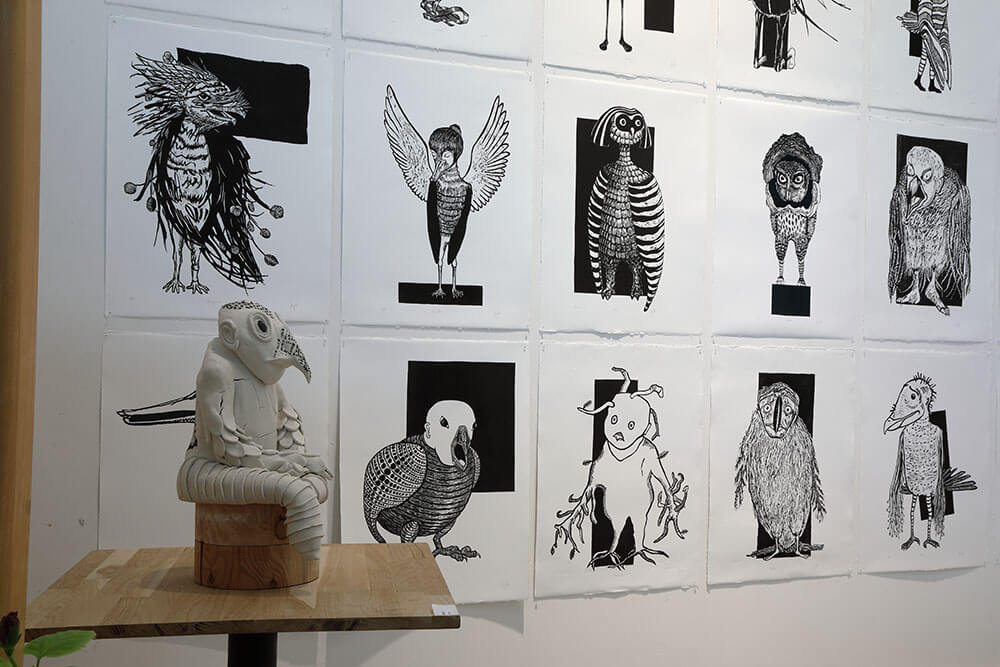
Thus, through absurd shortcuts, the physiognomy of these improbable birds juxtaposes exaggeratedly aggressive beaks, clumsy, exaggerated bellies, embryonic or damaged wings, roughly scaled and clawed feet, and oversized, questioning and scrutinising eyes. The matrices on ‘Japanese wood’ are worked with a gouge, at least for the silhouette of the main figure and its surrounding space. The body is refined with a Dremel tool which, depending on the cutter used, can produce a rough, slightly raw surface with the organic feel of tangled plumage, or conversely, a precise and delicate pattern. After printing, a first name delicately written in grey pencil is assigned to each of these full-length portraits. This allows them to be distinguished, as each of these specimens expresses an awareness of individuality and takes us back to a particular universe: Marguerite is a party girl who has not quite woken up, looking sly with her feathers ruffled after a night of partying; Pascal, corseted in his frock coat, has the hieratic bearing of a master of ceremonies; Martha has the satisfied, slightly ‘look at me’ air of a comic book character, a boastful allegory, an emblem ready to take its place on the bonnet of a luxury car; Arthur is a high priest from Assyria whose chasuble reveals cuneiform symbols; Louis is a martyr, the pest nailed to the barn door; Edgar is a lost pharaoh whose pschent recalls past greatness; Frank has the shaggy wings of a survivor of an oil spill; Violaine is melancholy, an enigmatic sphinx; Hector, a little silly, shows some affinities with the good-natured figure of the Shadocks. This constant, playful transformation gives way to a more solemn note, that of a fabulist artist who, beyond the visual jokes, tells us a little about ourselves, about the tragicomedy of our emptiness. At the end of this observation, we are not far from considering that the animal is a man like any other, unless it is the other way around.
The ‘ancestors’ are portrayed in headshots, framed in oval frames and old-fashioned passe-partouts, which would almost naturally suggest hanging them in the living room, above the sofa. Of immemorial ancestry, they clearly borrow some traits from alcids, gallinaceous birds and other testudinids. But this genetic mystery ends with the demands of aesthetics, and in this field, creatures always come from somewhere, in this case from observing a plate in Buffon's Natural History (1749), a visit to the Natural History Museum in Paris, or a snapshot taken at the Océanopolis aquarium or the Pont-Scorff zoo. The ‘ancestors’ sport shimmering hairstyles and adornments, delicately enhanced by bright, slightly acidic colours. Rather than considering the entire gallery, let's take the time to greet a few members of this community: André is an ‘official’, wearing the powdered wig of a magistrate of the queen to great effect; Gédéon, by chance or mockery, is a turtle's head perched on the talons of a bird of prey; Isidore sports the most impressive upturned and unruly sideburns, in the style of an Empire baron; and Pétronille, with her inquisitive eyes, is undoubtedly the Orwellian boss of the farmyard.
The ‘offspring’ undoubtedly owe their more dynamic and playful compositions to their young age and carefree nature. They stretch out in strings or farandoles on vertical formats that give the illusion of falling, like a variation on grotesques. More mischievous, they are captured in unusual positions, performing graceful and twirling choreographies. Their anatomy, subject to metamorphosis, is also more improbable than that of their elders. In addition to organic collages, prostheses or extensions are added here, giving them the appearance of comical little monsters. Some of these ‘offspring’ remind us of the legendary and marvellous beings known as astomates, sciapodes, cyclops and other ‘monkeys’ invented by copyist monks bored with their task and found in the marginalia2 of ancient manuscripts.
Sometimes these delightful creatures are incorporated into the décor of a small Roman-style theatre in the form of miniature cardboard cut-out figurines. They are arranged in front of a stage wall decorated with precious motifs, which add a touch of solemnity and poetry to this amusing teratology.
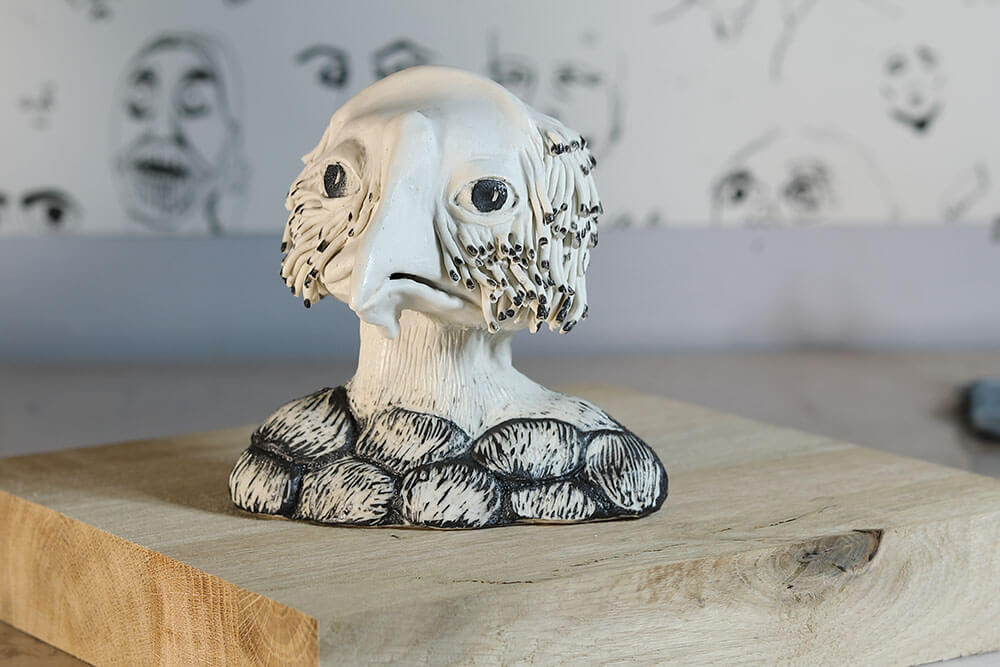
Some of these specimens, notably the ‘Great Elders’, have inspired sculptures in porcelain stoneware or paper porcelain, made from plaster moulds. The shape obtained after drying, which can be temporarily remodelled, is slightly unusual. The abbreviated, ghostly silhouette of the ‘Great Elders’ takes us back to the beginning of the work, to the certainty of the preparatory drawing. Hybridity remains the rule here: the model is that of a slender biped with a beaked or trunk-like head.
It all started with a drawing
Indeed, the legitimacy of this project is based on drawing and knowledge of nature. To be able to play so easily with living things, with representations of the animal and plant kingdoms, one must have an objective knowledge of them: in Violaine Fayolle's case, this meant disciplining herself to observe and practise drawing in order to unlock the secrets of nature, in the hope of recreating the variety and complexity of its forms.
The proximity and complicity with nature are evidenced by display cases in the studio that constitute a small cabinet of curiosities. The artist displays wonders, naturalia from the three kingdoms: bird feathers, amphibian skeletons, sea urchin shells, porcupine quills, dried kelp... to which must be added a few ‘dream stones’, one or two polished agates, blue and green, where the milky undulations of their concentric patterns spill forth. Not to mention the shells, whose ‘magic coat’3, delicate colours, orderly striations and scalloped growths provide a magnificent lesson in geometry. According to Didier Semin, these dreamlike forms deprive us of the privilege of believing that we alone are capable of intelligent construction4. All these wonders have been gleaned from travels and numerous hikes in the surrounding countryside. They have patiently built a ‘plastic joy’ that is an affirmation of the world or, to quote Caillois5, a happy acquiescence to the general order of nature.
For the rest, everything comes down to drawing, and everything begins with sketchbooks whose pages are filled with representations of multiple figures, constituting the bric-a-brac of a formal encyclopaedia, a universal primer dedicated to living things: pine cones, gnarled roots, birds' beaks, crustacean claws, oak acorns, spiny sweetgum capsules, maple samaras, interspersed with occasional references to art: Piero della Francesca, Holbein, Géricault, Giacometti, Maillol, Munch, Picasso, Redon, Rops, etc. While ‘nature-artist’ is an unsurpassable model, a direct source of inspiration, the prism of these illustrious predecessors can nonetheless be a beneficial shortcut. The preparatory drawing is multifaceted. It is documentary, exploratory, or more sensitively artistic. Sometimes it is completed and transferred onto wood in almost identical form. Conversely, it may remain suspended, awaiting an unlikely completion, as in the case of this starling, captured with a light, fragile stroke, only part of its plumage rendered with almost caressing swathes of black ink. The subject can be depicted in different poses on the same sheet, as is the case with the grey wagtail. Detailed drawings abound and concern both flora and fauna. Oak acorns, thistles and ears of wheat are rendered with the utmost precision, with the scrutinising accuracy of a meticulous gaze. In the case of birds, it is often the legs, the head, and more specifically the beak that attract attention. To avoid generalisation, it should be noted that some drawings seek primarily to convey not an exact physical appearance, but the sensitive truth of an attitude, the energy of a living expression: the flight or landing of a bird. A short handwritten text in the margins identifies the species, anticipates future artistic developments or specifies the technical ‘recipe’. Looking at these notebooks, one senses the creative project taking shape, drawing after drawing, growing in confidence. Through this slow and gradual possession of the visible, the artist opens up new perspectives. But this approach, however demanding and virtuous it may be, needs to be surpassed by a touch of fantasy and ingenuity, which are the foundation of the value of this mischievous teratology. These motifs are eventually distinguished and reproduced on large-format sheets that line the walls of the studio, like a call to order. These reproductions are the key to the work: manipulated like playing cards, like a natural history ‘your way’ that would not have displeased Raymond Queneau, or like the ‘abattis’, pieces of bodies, used by Rodin to reinvent anatomy. These motifs and figures, juxtaposed in this way, suggest the idea of infinite combinations and variations. This, then, is the ecology, the ‘niche’ of this work, which constantly feeds on a renewed view of nature. It is through the demand for a detailed descriptive line, which exhausts the figures of the visible, that the representation becomes strange and mysterious and that the artist's mind gives birth to this passionate and zany zoology, the excessiveness of new Calibans, griffins and other mandrakes, capable of enlarging the menagerie of his paper zoo6.
Yvon Le Bras, La Troménie, 10 May 2025
SOLO EXHIBITIONS (selection)
Coming soon October 2026 / Galerie La Bouée in Cherbourg (50)
April–June 2025 / Retrospective exhibition at L'Archipel, Cultural Centre, Fouesnant (29)
December 2023 / Exhibition at Espace Gallix, Paris 9th arrondissement
March–April 2022 / L'Hermine Cultural Centre in Sarzeau (56)
March–May 2021 / Charlie Hebdo Gallery at the Quimperlé Media Library (29)
May–August 2019 / Maison Tessier-Dit-Laplante, in Quebec City, Canada.
May 2019 / Atelier-Galerie Piroir, Montreal, Canada.
May – July 2017 / Tal Coat Gallery, Hennebont (56)
CREATIVE SUPPORT
July 2021 / €3,000 creative grant from DRAC Bretagne for a project entitled ‘La traversée du décor’ (Crossing the Set)
REPRESENTED BY
since 2022 / Galerie Gloux in Concarneau (29) – special exhibition of engravings in September 2023
since 2024 / Galerie Out of the Blue in Lille (59)
ACQUISITIONS / ADDITIONS TO PUBLIC COLLECTIONS
2025 / Bibliothèque nationale de France (BnF), Paris, Department of Prints and Photography
Donation from La Forêt, accepted and added to the heritage collections, work comprising 18 prints, format 63 x 90 cm
2025 / Quimper Earthenware Museum, acquisition of the sculpture Atticus
2025 / Acquisitions of prints at the Le Bief Cultural Centre in Ambert (63), the Chambéry Art Library (73), and the Archipel de Fouesnant (56)
2024 / Acquisition of prints at the Poitiers Art Library (86)
2021 / Acquisition of prints at the Compiègne Art Library (60) and Tergnier Art Library (02)
Jan 2019 / Donation of prints to the Woodcut Museum in Campos do Jordao, Brazil
Nov 2018 / Donation of prints to the Cultural and Artistic Department of Araraquara (Brazil)
2013-2017 / Acquisitions of prints at the Artothèque in Hennebont (56)
GROUP EXHIBITIONS (selection)
Coming soon / late April to early June / Exhibition Les fenêtres qui parlent (Windows that Talk) with Silex Ink, in Cosnes-sur-Loire
Coming soon / November 2025 / Pop-up exhibition organised by Fondalor in Lorient
May 2025 / Exhibition at the La bonne impression Festival, Centre Culturel le Bief, Ambert
May 2025 / Exhibition at Cadratin in Jouy-le-Moutier
May 2025 / Exhibition Entaille at the Taylor Foundation with Pointes et Burin, Paris
February 2025 / Traits d'union, Jeune Gravure Contemporaine, Paris, (6th arrondissement)
July 2023 / Galerie Imaginario, Blendlatino, Libertador, Buenos Aires, Argentina
December 2022 / 40th edition of ‘Les petits formats’ with the La Seine group, Galerie Mesnil'8, Paris
Spring 2022 / Exhibition of the magazine Le Bois gravé at the Taylor Foundation, Atelier Auger in Paris
November - December 2021 / Théâtres de papier at the Galerie Anaphora in Paris (5th arrondissement)
RESIDENCIES
June 2025 / Creative residency at Archipel de Fouesnant (29)
May 2019 / Working residency at Atelier Presse Papier in Trois Rivières, Quebec
EXHIBITIONS / BIENNIALS (BY INVITATION/SELECTION)
July-August 2021 / Morsure, Archipel de Fouesnant Cultural Centre (22)
7-20 September 2020 / High Graphics 2020, Naberezhnye Chelny, Tatarstan, Russia
June-September 2019 / International Engraving Biennial at the Xylography Museum in Campos do Jordao, Brazil
September 2014 / Morhange International Engraving Exhibition (57)
May 2009 / International Printmaking Biennial in Albi (81)
AWARDS
2025 / Arches – Antalis Prize awarded to the Taylor Foundation during the exhibition with Pointe et burin
2025 / 1st Prize from the Faience Museum during the Quimper Ceramics Festival
PARTICIPATORY PROJECT
June 2023 – 2025 / ‘Shared Curiosities’ – Fondalor winner and funding from the city of Lorient
WORKS OF ART IN PUBLIC SPACES
June 2025 / Permanent installation La ribambelle chosen by residents Place de la Rotonde in Lorient
May 2023 / Sculptures Les confidences de Bertille et Ferdinand – Lycée Dupuy de Lôme in Lorient
May 2023 / Metal frescoes Les désailés mettent les pieds dans le plat – Lycée Dupuy de Lôme in Lorient
STAGING/PERFORMANCE
2017-2021 / Creation of a show with a trio of musicians (set design, dance, mime, painting), Grain de Sel lighting design residency in Séné (56) and performance of the show for the general public and school audiences
EXHIBITION CURATOR
2022 / Curator of Morsure, including the organisation of a professional weekend at the Archipel de Fouesnant (29)
PROFESSIONAL TRAINER
2024-2025 / Woodcut trainer at the Musée Atelier de l’Imprimerie in Nantes
2024-2025 / Woodcut trainer for the Topo organisation (www.topo-art.org) in Paris
BIBLIOGRAPHY / PUBLICATIONS
May 2023 / Creation of a print used as a poster for the Fête de l'estampe (Manifestampe)
June 2012 / ‘Le faiseur d'image’ (The image maker), original cover and article in the magazine Le bois gravé, no. 22
WORK PUBLISHED IN ART BOOKS
February 2023 / Practising intaglio engraving, ‘Les techniques de l'estampe’ (Printmaking Techniques), Olivier Dekeyser, Editions Eyrolles
Nov 2025 / Interview in the international art magazine The Wise Owl, No. 48
WORK PUBLISHED IN SPECIALISED JOURNALS
Nov 2025 / Interview dans la revue internationale d’art The wise owl, n°48
Jan. 2023 / Article on Les Désailés in the Belgian journal Actuel de l’estampe contemporaine, no. 26
EAC PROJECTS
since 2022 / Pass Culture reference, numerous projects each year with middle and high school students
OTHER PROFESSIONAL INFORMATION
SIRET no.: 504 637 091 00035 / Maison des Artistes no.: F435284
April 2023: position of general secretary at the office of the National Printmaking Federation, Manifestampe.
Member of the Taylor Foundation since 2022 / Member of the JGC association since May 2023